BiOrbic Highlights the Role of the Bioeconomy in Supporting a Healthy Ireland
In their submission to the Healthy Ireland Framework public consultation, BiOrbic has emphasised that the transition to a sustainable, circular bioeconomy is both an environmental and economic imperative and presents a significant opportunity to improve population health and wellbeing.
The bioeconomy and human health relationships explored below are not exhaustive. BiOrbic welcomes continued engagement with the Healthy Ireland team in further developing these ideas and in supporting the integration of bioeconomy perspectives within the Framework.
- Healthier Living Environments and Nature Supporting Wellbeing
Health and wellbeing are strongly influenced by the quality of the environments in which people live, work and spend time. Access to healthy ecosystems and natural environments is increasingly recognised as an important determinant of health and wellbeing.
The bioeconomy can contribute to this objective by supporting a transition away from fossil-based, single-use products towards more renewable and resource-efficient systems of production and consumption. In doing so, there are significant potential co-benefits for public health, including reduced environmental pollution, lower greenhouse gas emissions and improved ecosystem integrity.
Within the Healthy Ireland Framework, there is opportunity to more explicitly recognise the role of nature as both a provider of ecosystem services and a determinant of health and wellbeing. Strengthening the protection and restoration of ecosystems should therefore be viewed not only as an environmental objective, but also as a public health measure that supports long-term population wellbeing.
- Sustainable Food Systems
There is growing recognition that sustainable food systems are central to addressing the interconnected challenges of climate change, public health and resource security.
In Ireland, the current food system contributes substantially to greenhouse gas emissions, poor water quality and wider ecosystem degradation, while also failing to deliver equitable health outcomes. This is reflected in the coexistence of undernutrition, obesity and diet-related non-communicable diseases.
This reflects a misalignment between food production systems, future food delivery and nutritional needs, reinforcing the need for more integrated, systems-based approaches that explicitly considers both environmental and health outcomes.
The Healthy Ireland Framework presents an important opportunity to begin addressing how sustainable diets, derived from a more sustainable food system, may be considered within the context of a healthy Ireland.
- Culture, Communities and Sustainability
There is increasing recognition that health and wellbeing are shaped by a broad range of social, cultural and environmental determinants beyond formal healthcare systems.
Within this context, we recognise that communities and culture play a critical role in shaping how individuals understand, experience and act on sustainability. Engagement with sustainability through education and community-based initiatives can strengthen public understanding of the links between ecosystem integrity and human wellbeing.
We believe the Healthy Ireland Framework offers an opportunity to recognise how community and cultural contexts shape engagement with sustainability, helping to support more inclusive and locally grounded pathways to wellbeing.
- Some Examples of BiOrbic Projects that Align with the Above
Farm Zero C illustrates emerging pathways toward lower-emissions, climate-neutral agricultural systems and demonstrates the potential for aligning environmental sustainability with food production.
The ReFarm project is bringing together experts in natural sciences, agriculture and business to investigate how biodiversity recovery within food systems can be financed and rewarded, potentially addressing access to more sustainably produced food.
The RestPoll project is testing pollinator conservation strategies and tools in the Irish landscape to develop options for pollinator restoration within agri-ecosystems.
The UCD Lyons long-term grazing platform is developing blueprints to enhance the sustainability of pasture based livestock production systems. Results from the study show that multispecies swards (grazing pasture with a greater diversity of grasses, herbs and legumes) allow animals to reach their target weight earlier than the standard perennial rye grass sward while also requiring less chemical nitrogen input.
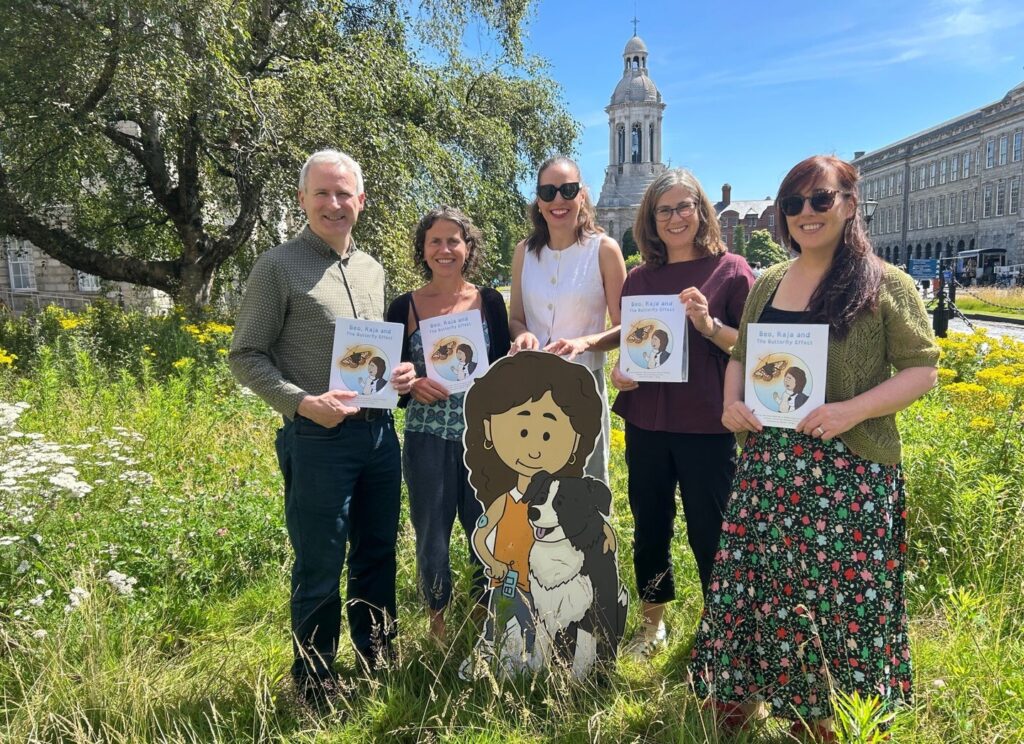
BioBeo is a Horizon Europe-funded project that promotes public engagement with the bioeconomy through education and community participation. Its work highlights how culture and education can support sustainability awareness, environmental stewardship and wellbeing.
BEST Network supports bioeconomy and sustainability education through collaboration between researchers, educators and communities.