
On Tuesday 1st September, Minister for Agriculture, Food and the Marine (DAFM) Martin Heydon TD officially launched Ireland’s first on-farm demonstration plant integrating grass biorefining and anaerobic digestion. This €3 million demonstration plant, funded by DAFM, is based at Shinagh Estates, Co. Cork, also home to Farm Zero C. This new plant will open up new markets for surplus grass, creating high-protein feed, bio-packaging materials, bioenergy and biofertilisers.
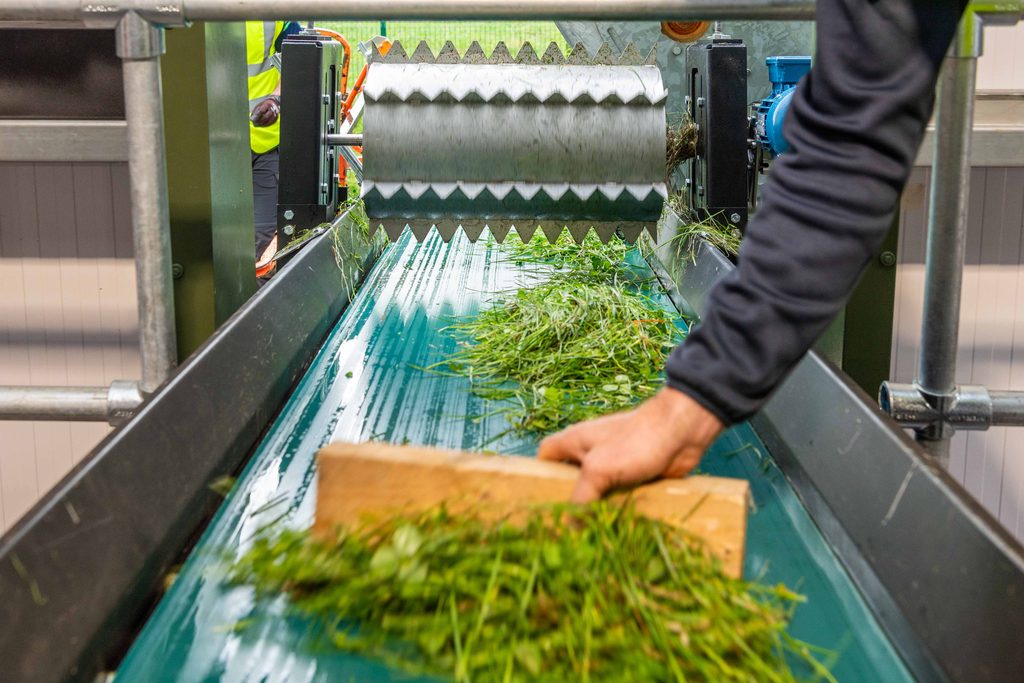
The launch represents an important step in a longer journey of exploring how Ireland can create more value from its grass-based agricultural system. In recent years, a series of connected projects and partnerships have explored how grass can support a sustainable and circular agricultural system, while creating new opportunities for farmers, industry and the wider bioeconomy.
In 2019, the Biorefinery Glas project took an important first step by exploring the potential for grass biorefining in Ireland. A partnership between Munster Technological University, Carbery and European partners, used a mobile grass biorefinery developed in the Netherlands to demonstrate how grass could be processed to create greater value from Ireland’s existing agricultural resources.
Around the same time, a broader focus was emerging around the future of dairy farming such as reducing emissions, increasing biodiversity and exploring new opportunities for farmers. Discussions between BiOrbic’s Director, Prof. Kevin O’Connor, and Carbery’s Head of Sustainability, Enda Buckley, began exploring this challenge in 2018. When Research Ireland (formerly SFI) launched its Net Zero Challenge in 2019, BiOrbic brought together researchers and industry partners to develop what became Farm Zero C.
The project brought together expertise that would not normally sit in one place through Prof. Jane Stout’s work in biodiversity, Dr. Fionnula Murphy’s expertise in life-cycle assessment, Carbery and Shinagh Farm’s experience of sustainability and farming, and Prof. James Gaffey’s work on grass biorefining, business models and dissemination.
Rather than looking at one technology in isolation, the team developed a phased approach to transforming the farm system. The first phase focused on reducing greenhouse gas emissions and increasing biodiversity at farm level, with the ambition to test and refine the approach across a growing network of farms. The vision included 10 initial replicator or monitor farms, with the ambition to expand to more than 100.
As part of the second phase, grass biorefining and anaerobic digestion were identified as technologies that could offer opportunities to extract greater value from agricultural resources. These technologies could open up new markets and create new products from resources already available within the agricultural system, but would require significant investment, infrastructure and further development to move towards deployment.
Over the following years, the Farm Zero C team explored funding opportunities for grass biorefining and anaerobic digestion, eventually securing Department of Agriculture, Food and the Marine funding to support the infrastructure needed to progress the work. Developing the grass biorefinery itself took more than three years of planning, budgeting and procurement.
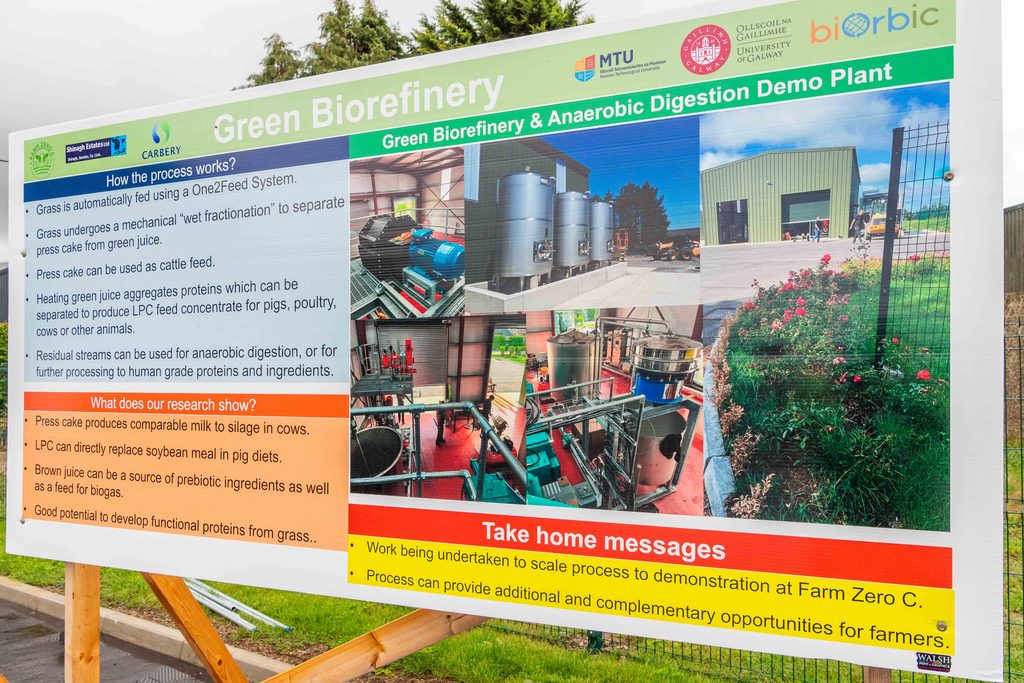
At the same time, the research network continued to grow. In 2024, Prof. James Gaffey, Prof. Vincent O’Flaherty, Prof. Kevin O’Connor, Prof. Pat Guiry and other BiOrbic colleagues, together with European partners, secured the BioRefarmeries EU project. This opened a new route for integrating grass biorefining into the Farm Zero C work and connecting the Irish activity with wider European research and innovation.
The result is more than a single project. It is a pathway that has connected grass biorefining and next generation anaerobic digestion demonstration with research on net zero-emissions farming, biodiversity and international collaboration.
The launch at Shinagh marks an important point in that pathway, bringing this work from research and demonstration towards practical application. It also illustrates the value of bringing different parts of the bioeconomy ecosystem together.
Attending the launch, BiOrbic Executive Director Derek O’Brien commented, “By connecting researchers, farmers, industry, infrastructure, funding and international partners, BiOrbic has helped create the conditions for an idea to move from research through to scale-up demonstration and towards practical application”.